 AllScan
AI Banknote Scanner: Identify Any Currency & Value
Upload a photo of any banknote. AllScan AI identifies the currency, denomination, year of issue, and estimated collector value for free.

Drag a photo here or tap to upload
Analyzing banknote...
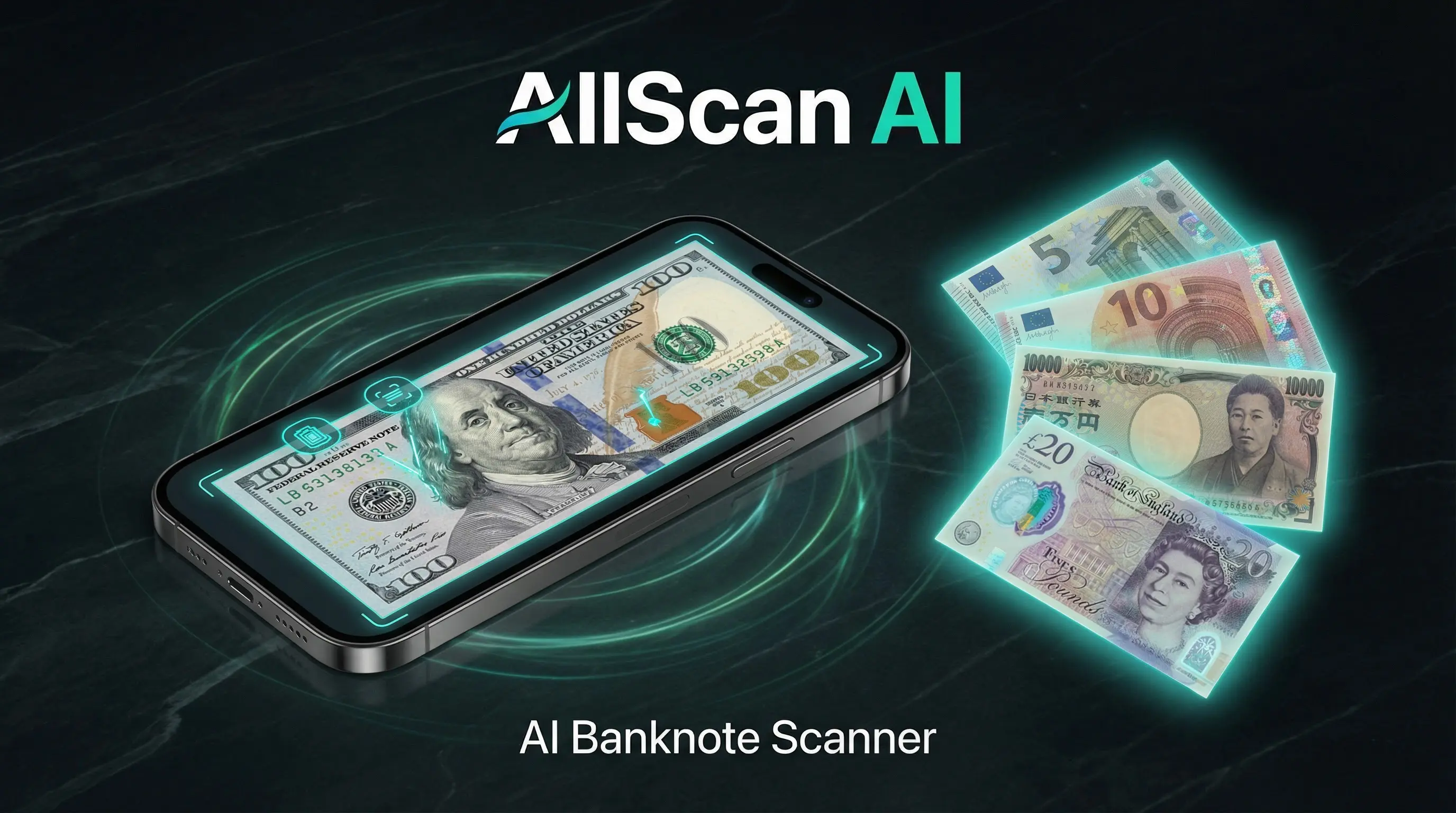
What Is AI Banknote Identification?
AI banknote identification uses image recognition to analyze a photograph of paper currency and determine its country of origin, denomination, series, and approximate year of issue. The AI examines design elements, portraits, security features, color schemes, and serial number formats to match the note against a reference database. This technology serves collectors, travelers, and anyone who encounters unfamiliar currency and wants quick information about it.
Design Pattern Recognition
Every banknote carries a unique combination of design elements specific to its country and issue period. Portraits, landmarks, geometric patterns, and color palettes form a visual signature. The AI reads these patterns and compares them against reference images of known banknotes. Design changes between series help the model distinguish between different issue years of the same denomination. A US $100 bill from 1990 looks different from a 2013 issue, and the AI recognizes these distinctions.
Serial Number and Text Analysis
Banknotes contain printed text including serial numbers, denomination numerals, issuing bank names, and date information. The AI applies optical character recognition to extract this text and cross-references it with known serial number formats. This adds a second layer of identification beyond visual design matching. Serial number prefixes and suffixes often indicate the specific print run, which is relevant for collector value assessment.
Collector Value Estimation
After identifying the note, AllScan AI references recent auction results and dealer listings to provide an approximate market value. Value depends on the note's rarity, condition, serial number characteristics, and current collector demand. The AI coin scanner uses a parallel approach for numismatic items, combining visual identification with market data to estimate collector premiums.
How to Use AllScan AI Banknote Scanner
Photograph the Banknote
Place the banknote on a flat, well-lit surface. Photograph the full note without cropping edges or corners. Avoid shadows cast by your hand or camera. Both the front (obverse) and back (reverse) sides contain identification features, so consider uploading each side separately. Natural daylight or diffused artificial light produces the clearest images for accurate recognition.
Upload to AllScan AI
Drag the photo into the upload zone or tap to select a file. The AI processes JPG, PNG, and WebP formats. Analysis starts automatically. The scan examines design patterns, text, serial numbers, and color information to identify the note. Results typically appear within a few seconds.
Review the Identification
The result displays the country of origin, denomination, estimated issue year, series information, and approximate collector value. Use this data as a starting point for further research if you are buying or selling. For portable banknote scanning while traveling or at shows, download the AllScan AI app for free daily scans.
Banknote Scanning Features and Applications
Currency Identification for Travelers
Travelers often receive unfamiliar banknotes during international trips. Different denominations within the same currency can look similar to someone unfamiliar with the design system. A reverse image search can also help identify unfamiliar currency by finding matching images across the web. AI banknote scanning provides instant identification, showing the denomination value and the current exchange rate context. This is especially useful in countries that have recently redesigned their currency or in regions where multiple currencies circulate alongside each other.
Banknote Collecting and Numismatics
Paper money collectors use AI scanning to quickly identify notes found at estate sales, flea markets, and dealer inventories. The AI provides the baseline identification that determines which catalog reference to consult. Collector value varies significantly between common issues and rare varieties. Notes with star serial numbers, low print runs, or printing errors often carry premiums that the AI can flag when the visual indicators are present. Collectors looking to buy or sell banknotes online can also use the product search tool to find current marketplace listings.
Historical and Obsolete Currency
Banknotes from countries that no longer exist, currencies that have been replaced, and historical issues from past centuries are of interest to collectors and historians. The AI recognizes many obsolete notes, including those from former Soviet states, pre-Euro European countries, and colonial-era issues. Coverage depends on the availability of reference images in the training data. Well-documented historical currencies are identified more reliably than obscure or short-lived issues.
Condition Assessment from Photos
The physical condition of a banknote significantly affects its collector value. Professional grading uses a scale from Poor to Superb Gem Uncirculated. The AI estimates a general condition category based on visible wear, folds, tears, stains, and crispness in the photograph. This estimate is approximate. Professional third-party grading services examine notes in person using standardized criteria and provide certified grades that dealers and collectors trust for transactions.
Error Notes and Rare Varieties
Printing errors on banknotes create rare varieties that collectors prize. Misaligned prints, missing serial numbers, inverted overprints, and fold-over errors are examples. The AI can detect some visible errors when the anomaly is clear in the photograph. Subtle errors that require magnification or UV light are beyond the AI's capability from a standard photo. If the AI flags potential error indicators, have the note examined by a specialist before assuming premium value.
Limitations and Safety
AI banknote scanning is an informational tool, not a counterfeiting detection system. The AI cannot verify watermarks, security threads, microprinting, UV-reactive features, or intaglio texture from a photograph. Physical examination with proper tools remains the standard for authenticity verification. Law enforcement and banking professionals use specialized equipment that exceeds what any image-based tool can provide.
Value estimates are based on publicly available market data and represent general ranges, not guaranteed sale prices. The actual price realized at auction or through a dealer depends on factors including buyer demand, note provenance, current market trends, and the specific grading assigned by a professional service. Do not make purchasing or insurance decisions based solely on AI-generated estimates. The AI antique scanner carries similar limitations for valuing physical collectibles from photographs.
Image quality is critical for accurate identification. Banknotes photographed at an angle, with flash reflections, or with portions outside the frame may be misidentified. Heavily worn notes where design details have faded present challenges for the recognition model. Counterfeit notes of sufficient visual quality may be misidentified as genuine, and genuine notes in poor condition may receive inaccurate identifications. Always cross-reference AI results with catalog references for important decisions.
Frequently Asked Questions
How does AI banknote identification work?
AI banknote identification uses image recognition to analyze visual features on the note, including portraits, serial numbers, security features, and design elements. The model compares these against a database of known banknotes to identify the currency, denomination, and approximate issue year.
Can AI estimate the value of a banknote?
AllScan AI provides approximate collector value estimates based on the note's identification, condition category, and recent market data for similar notes. These estimates are not certified appraisals.
What types of banknotes can the AI identify?
The AI recognizes banknotes from over 150 countries, including current circulating notes and many historical issues. Common currencies like USD, EUR, GBP, and JPY have the deepest coverage.
Is the AI banknote scanner free?
AllScan AI offers free daily banknote scans on the web and mobile app. No registration is needed to use the web tool.
Can AI detect counterfeit banknotes?
AI can flag some visual indicators that differ from genuine notes, but it cannot confirm authenticity. Physical inspection with UV light, watermark checks, and tactile features is required. Do not rely on AI for counterfeit detection.
What photo quality is needed for banknote scanning?
Use a well-lit, flat photo of the full banknote. Both front and back can be scanned separately. Avoid shadows, reflections, and cropping that removes serial numbers or design elements.
Does the AI identify old or obsolete banknotes?
The AI recognizes many historical banknotes from the 19th and 20th centuries. Coverage is strongest for well-documented currencies. Very rare or obscure regional notes may not be in the database.
Can I scan both sides of a banknote?
Yes. Upload the front and back as separate images. Each side is analyzed independently. Scanning both sides often provides more complete identification.
How does banknote condition affect value?
Banknote condition is graded on a scale from Poor to Uncirculated. Notes in better condition command higher collector premiums. The AI estimates a general condition category from the photo, but professional grading is more accurate.